



TMS therapy cost depends mainly on the number of sessions in your treatment plan and how much your insurance covers. Without insurance, a full course of standard TMS usually costs about $6,000 to $15,000, or roughly $200 to $500 per session. Many insurance providers now cover TMS for conditions such as major depressive disorder and OCD, and some plans cover most of the cost. If you are paying on your own, many TMS clinics offer financing. This guide explains what shapes your final cost and how to manage it.
What You Pay for With TMS Therapy
Transcranial magnetic stimulation is a non-invasive treatment that uses magnetic pulses to activate nerve cells in areas of the brain linked to mood. It does not require surgery or anesthesia, and there is no recovery period. Patients return to their day after each visit. This means there are no hospital stays or anesthesia fees added to the bill.
Average Cost of TMS Therapy
No single price applies to every patient. Your cost depends on your diagnosis, the TMS approach chosen for you, and your insurance plan. Two patients can receive very different bills even with the same diagnosis.
Typical self-pay prices at U.S. clinics:
- Standard TMS (rTMS, NeuroStar): about $200 to $500 per session, or $6,000 to $15,000 for a full course of 30 to 36 sessions.
- Deep TMS: about $350 to $600 per session, or $10,000 to $18,000 for a full course.
- Accelerated SAINT TMS: about $30,000 to $36,000 for the full protocol. Commercial insurance usually does not cover it.
- Initial evaluation: about $100 to $300.
Prices sit toward the top of these ranges in high-cost cities. With insurance, most patients pay their deductible plus a copay or coinsurance for each session instead of the full price.
For a broader look at national pricing, read our guide on TMS cost. For many patients, insurance benefits matter more than the list price.
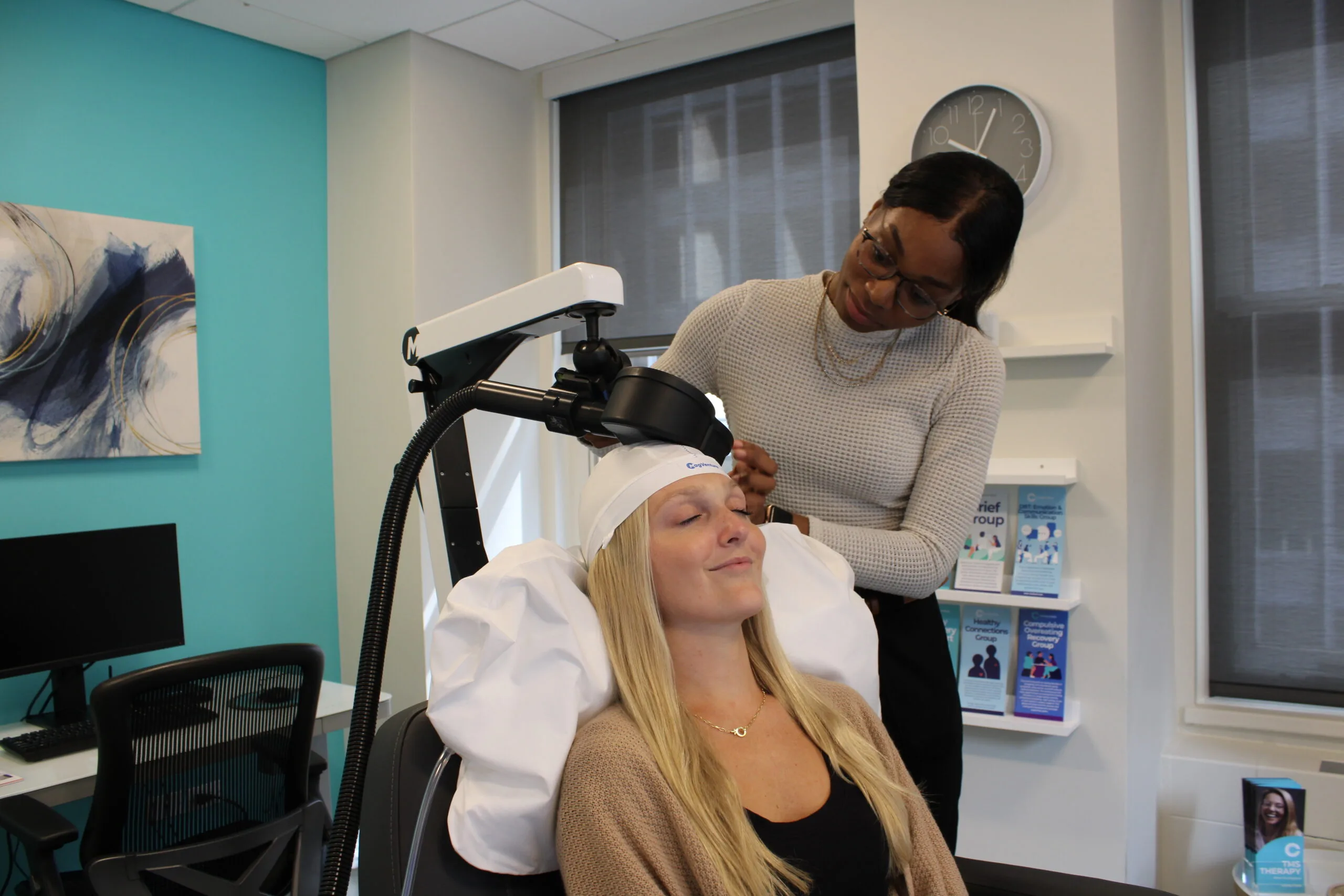
A provider positions the TMS coil before a treatment session.
Cost Per Session and Total Treatment Estimate
TMS is given as a course of treatment, not as a single visit. A standard course involves frequent sessions over several weeks. Your total cost is the per-session rate multiplied by the number of sessions in your plan. For example, 36 sessions at $250 each comes to $9,000.
That is why it helps to look at the full course rather than one appointment. A lower per-session rate does not always mean a lower total if your plan needs more visits. Our guide to TMS treatment duration explains how long a typical course lasts.
Cost of Accelerated TMS
Some clinics offer Accelerated TMS, including Accelerated Deep TMS and the SAINT TMS approach. Accelerated protocols pack more sessions into fewer days, aiming to finish treatment in a shorter time frame.
Because the sessions are condensed, the pricing structure can differ from a standard course. The SAINT protocol usually costs about $30,000 to $36,000 at U.S. clinics, while some other accelerated programs cost closer to $10,000. Insurance plans may also treat accelerated protocols differently than standard TMS. To learn more about how this approach works, see our overview of the SAINT TMS protocol.
Initial Consultation and Maintenance Session Fees
Your first visit with a TMS provider sets the plan that drives your total cost. At this visit, the provider reviews your history and past treatments and confirms whether TMS fits your needs. You should leave knowing which type of TMS is recommended and roughly how many sessions to expect. If you pay on your own, this evaluation typically costs about $100 to $300.
Some patients return later for maintenance sessions to help keep their results steady. These are usually billed per visit, at about the same $200 to $500 rate as a regular session, and only when needed. Ask the clinic to explain any maintenance costs up front.
Factors Influencing TMS Therapy Pricing
Several factors shape what you pay. Knowing them helps you compare estimates and ask the right questions.
Location and Clinic Reputation
Costs vary by region. Rent, staffing, and local demand all affect what an office charges. A clinic’s experience with TMS can also affect pricing, since offices with a long record of treating patients may set rates differently.
When comparing options, look at the full plan rather than the per-session figure alone. Our article on find TMS clinics lists the questions worth asking.
Type of TMS Technology Used
Clinics use several TMS approaches, including NeuroStar TMS Therapy, Deep TMS, and rTMS. Each device and protocol carries its own equipment and training costs, which can affect the price per session.
The right technology depends on your condition, not on price alone. For example, TMS is used for OCD as well as for depression. You can compare the options in our guide to the types of TMS or read about TMS vs Deep TMS.
Number of Sessions Required
Session count is the largest driver of total cost. Most patients complete a full course over several weeks. Some respond quickly, while others need extra sessions or later maintenance visits.
Your provider sets your session count based on your diagnosis and how you respond during treatment. Sticking with the full plan gives TMS the chance to work and avoids paying for a partial course that falls short.
Additional Services and Fees
Some patients pair TMS with other care. Many clinics also offer counseling, medication management, and psychiatric evaluation, and some offer combined plans such as rTMS with Spravato or TMS with ketamine. Each added service affects your total cost, and insurance may cover them under different rules.
Paying for TMS Therapy Without Insurance
Some patients have no coverage, or their plan denies TMS. Paying on your own is still possible with some planning.
Out-of-Pocket Costs
Without insurance, you pay the full cost of each session in your plan. At $200 to $500 per session, a standard course usually adds up to $6,000 to $15,000. Ask for an estimate that covers the full course rather than a single visit. This gives you a clear picture before you commit.
Many patients find that a full-course estimate makes budgeting much easier than a per-session quote.
Payment Plans and Financing Options
Many clinics offer financing for TMS and for Spravato. Financing lets you spread the cost over time instead of paying for the full course at once. This can make treatment possible for patients who would otherwise put it off.
Ask each clinic to walk you through its financing choices. The goal is a monthly amount that fits your budget.
Financial Assistance and Discounts
Ask the clinic about any savings that may apply to your situation. Combining financing with HSA or FSA funds is one way many patients lower what they pay each month. Some patients also find that partial insurance coverage, paired with financing for the remaining balance, keeps costs manageable.
Is TMS Therapy Worth the Cost?
The value of TMS depends on what you have already tried and how much your symptoms affect daily life. For many patients, it fills a gap that medication alone has not.
Effectiveness Compared to Other Treatments
TMS is often used for treatment-resistant depression, which means depression that has not improved with standard medications. It works by stimulating nerve cells in mood-related areas of the brain. Many patients notice better mood along with improved concentration and sleep.
TMS also avoids the systemic side effects that come with some medications, since it does not circulate through the body. Other options for treatment-resistant conditions include Spravato and ketamine therapy. To see how they compare, read TMS vs Spravato or TMS vs ketamine.
Long-Term Value and Considerations
Think about cost over time, not just the upfront price. Years of trying medication after medication add up in copays and missed days. TMS is given as a set course, so the cost has a clear start and finish. Some patients need maintenance sessions later, which is worth factoring into your budget.
Your results also affect long-term value. When TMS works, patients often find it easier to return to work and keep up with daily life. Our article on whether you are a good TMS candidate can help you judge if the investment makes sense for you.

A patient relaxing in a TMS treatment chair during a session.
How to Find Affordable TMS Therapy
A few steps can bring your costs down and help you avoid surprise bills.
Tips for Reducing TMS Therapy Costs
Start with your insurance benefits. Know your deductible and copay before treatment begins. Ask about pre-authorization early, since delays can push back your start date.
Keep records of past treatments. Insurers often want proof that you tried medications first, and complete records speed up approval. Use HSA or FSA funds if you have them. Compare full-course estimates rather than per-session prices. Ask about financing if you need to spread out payments.
Finishing your full course also protects your investment. Stopping early can mean paying for sessions that did not have time to work.
Finding Clinics That Accept Insurance and Offer Financial Support
When choosing a TMS office, ask whether the team verifies insurance and handles pre-authorization. Ask about financing too. Comparing a few clinics near you makes it easier to find one that fits your coverage and budget.
Clinics that handle verification and pre-authorization take much of the paperwork off your plate. That leaves you free to focus on your treatment. For more on what coverage looks like, see our guide on TMS insurance coverage.
Conclusion
Your TMS cost depends on the number of sessions you need and how much your insurance covers. Without insurance, a standard course usually runs about $6,000 to $15,000. Many plans now cover TMS, and many clinics offer financing for patients paying on their own. Understanding these factors early helps you plan with confidence and get the most value from your treatment.
